Pre-launch · Enquiries only. No contracts or orders yet.Vor dem Start · Nur Anfragen. Noch keine Verträge oder Aufträge.
Scientific Marketing & Software
Scientific rigour, applied to marketing and software.We understand your science. We understand your business. We help you grow.Scientific software for specialised professional work.
Specialized marketing expertise for life-science and scientific B2B companies, and purpose-built software for specialized professional work.
SCIENTIFIC MARKETING SERVICES
Specialized marketing expertise for science-led companies.
Select a service to explore its scope.
SCIENTIFIC SOFTWARE
Purpose-built digital products for specialized professional problems.
PRODUCT
🍃 FoodTrace AI
for food-import quality teams
Software built to support professional review of supplier documents, keeping human judgement at the centre of the document-review workflow.
FOUNDATION
Built by a pharmaceutical marketer with biopharma laboratory experience.
Founded by A S M Sazzad Ul Karim, whose career spans pharmaceutical marketing, analytical biopharma laboratory practice, and scientific digital marketing — three areas that rarely sit within one professional profile.
Pharmaceutical marketing→Analytical biopharma→Scientific digital marketing
Analytical biopharma experience — HPLC-based method development and biosimilar characterisation.
Start a conversation.
Whether that is a visibility audit, ongoing marketing support, one specific challenge, or a question about FoodTrace AI.
SCIENTIFIC MARKETING SERVICES
How can we support your business?
Select a service to explore its scope.
SCIENTIFIC SOFTWARE
Scientific Software
Purpose-built digital products for specialized professional problems, including FoodTrace AI.
SERVICE
Scientific Digital Visibility
Understand, improve and monitor your scientific digital presence.
SELECT AN AREA
Scientific Digital Visibility Audit & OSDVI
A clear, evidence-based view of how visible your science is online.
OSDVI is the Oenlo Scientific Digital Visibility Index: Oenlo’s structured approach to evaluating scientific digital visibility.
WHAT YOU RECEIVE
Audit assessment of your public scientific digital presence
Your OSDVI result
Key findings
Improvement recommendations
Based on publicly available information. No access to your internal accounts is needed.
90-Day Visibility Action Plan
Turn your findings into a prioritized roadmap.
WHAT THE PLAN INCLUDES
Prioritized improvement actions
A structured 90-day sequence with milestones
Dependencies and responsibilities
Measurement points
Builds on your audit. Hands-on implementation support is available separately.
Scientific LinkedIn Visibility
Strengthen how your company and experts appear on LinkedIn.
Company page presence and positioning
Scientific content direction
Expert and leadership profile positioning
Thought-leadership support
AI Visibility
Help AI-powered search understand and find your science.
Assessment of how your science appears in AI-powered search
Scientific information clarity review
Entity and content recommendations
Practical improvement steps
Visibility Monitoring
Track your progress with regular, comparable measurement.
Periodic measurement against OSDVI and agreed indicators
Includes AI-search visibility where relevant
Reporting and progress evaluation
Improvement recommendations
SERVICE
Scientific Product Management & Launch
Specialist product marketing expertise for pharmaceutical, biotechnology and life-science businesses.
Choose the support you need, from a single activity to a defined project.
Scientific Product Management
A clear commercial and scientific foundation for your product.
Product strategy and lifecycle support
Market and competitor analysis
Product positioning and differentiation
Scientific messaging and value proposition
Customer and stakeholder insights
Product performance review
Product Launch Strategy & Support
Strategic planning, launch preparation and selected marketing implementation support.
Go-to-market and launch strategy
Pre-launch planning and launch readiness
Launch messaging and marketing materials
Digital launch campaign development and selected implementation
Offline launch planning and coordination support
Post-launch performance review
SCIENTIFIC MARKETING PARTNER
Scientific Marketing Partner
Your ongoing external scientific marketing partner.
Recurring, agreed marketing capacity
Shared marketing planning and priorities
Dedicated point of contact
Campaign and content coordination
Regular communication and performance reporting
Flexible marketing support within the agreed scope
For companies needing continuous specialist marketing collaboration.
SCIENTIFIC MARKETING ON-DEMAND
Scientific Marketing On-Demand
Specialist scientific marketing support when you need it.
Support for specific assignments or projects
Flexible, time-bound engagements
Temporary specialist marketing capacity
Clearly agreed scope and deliverables
Project-based or hourly arrangements
No ongoing retainer commitment
For companies needing specialist expertise for a defined task, project or temporary capacity gap.
Impressum
Impressum — Angaben gemäß § 5 DDG
Oenlo UG (haftungsbeschränkt) i. G.
Hafenallee 61 63067 Offenbach am Main Deutschland
Vertreten durch: Geschäftsführer A S M SAZZAD-UL-KARIM
Unternehmenswebsite und geschäftliche Anfragen · Stand: November 2026
1. Verantwortlicher
Verantwortlicher für die in dieser Erklärung beschriebenen Verarbeitungen ist:
Oenlo UG (haftungsbeschränkt) i. G.
Hafenallee 61
63067 Offenbach am Main, Deutschland
Vertreten durch den Geschäftsführer: A S M Sazzad-Ul-Karim
E-Mail: asmsazzadulkarim@gmail.com
Telefon: +49 176 42066898
2. Geltungsbereich
Diese Erklärung gilt für den Besuch unserer Unternehmenswebsite, für Kontaktformular-Anfragen, E-Mails und andere geschäftliche Anfragen sowie für die Kommunikation im Zusammenhang mit der Erbringung wissenschaftlicher Marketingleistungen. FoodTrace AI hat eine eigene Datenschutzerklärung.
3. Hosting und Server-Logfiles
Unsere Website wird von ALL-INKL.COM – Neue Medien Münnich (Deutschland) gehostet. Beim Aufruf der Website werden technisch notwendige Zugriffsdaten verarbeitet. Dazu können IP-Adresse, Datum und Uhrzeit, aufgerufene Seite, Referrer, Browser- und Geräteinformationen sowie Verbindungs- oder Fehlerangaben gehören.
Wir verarbeiten diese Daten, um die Website bereitzustellen und abzusichern und um technische Störungen zu beheben. Rechtsgrundlage ist Art. 6 Abs. 1 lit. f DSGVO (sicherer und zuverlässiger Betrieb der Website). Server-Logfiles werden nur so lange gespeichert, wie es für diese Zwecke erforderlich ist.
4. Geschäftliche Anfragen und Kontaktformular
Wenn Sie uns kontaktieren oder unser Website-Formular absenden, verarbeiten wir die von Ihnen angegebenen Daten: Name, Unternehmen, E-Mail-Adresse, berufliche Funktion, Website, gewählte Leistung, leistungsbezogene Angaben, Nachricht und bevorzugte Sprache. Wir nutzen diese Angaben, um Ihre Anfrage zu prüfen, zu beantworten, eine mögliche Zusammenarbeit zu besprechen und Angebote vorzubereiten.
Rechtsgrundlage ist Art. 6 Abs. 1 lit. f DSGVO (Beantwortung geschäftlicher Anfragen). Zusätzlich gilt Art. 6 Abs. 1 lit. b DSGVO, soweit die Verarbeitung für einen Vertrag mit Ihnen als natürlicher Person oder für vorvertragliche Maßnahmen auf Ihre Anfrage erforderlich ist. Die Angabe einer E-Mail-Adresse und ausreichender Informationen zum Verständnis Ihrer Anfrage ist erforderlich, wenn Sie eine Antwort wünschen.
5. Anfragenverwaltung mit Google-Diensten
Unser Kontaktformular sendet die eingegebenen Informationen direkt aus Ihrem Browser an einen Google-Apps-Script-Endpunkt. Google kann dabei technische Verbindungsdaten, einschließlich Ihrer IP-Adresse, erhalten. Das Skript speichert die Anfrage in Google Sheets und sendet dem Gründer eine Benachrichtigung über Gmail.
Unser CRM kann zusätzlich Anfragequelle, Status, Priorität, Wiedervorlagetermine, interne Notizen und die zugehörige Korrespondenz enthalten. Diese Angaben dienen der Organisation und Beantwortung von Anfragen; auch interne Notizen können personenbezogene Daten sein.
Rechtsgrundlage ist Art. 6 Abs. 1 lit. f DSGVO (Organisation und Beantwortung von Anfragen).
6. Kundenbeziehungen und Rechnungsstellung
Wenn eine Geschäftsbeziehung zustande kommt, verarbeiten wir gegebenenfalls geschäftliche Kontaktdaten, Projektkommunikation, Vertragsunterlagen und Rechnungsdaten zur Leistungserbringung, Verwaltung und für gesetzliche Aufbewahrungspflichten. Rechtsgrundlagen sind Art. 6 Abs. 1 lit. b, c oder f DSGVO, abhängig von der jeweiligen Tätigkeit und davon, ob Sie persönlich Vertragspartner sind. Unterlagen, die gesetzlichen Aufbewahrungspflichten unterliegen, werden für die jeweils geltenden gesetzlichen Fristen aufbewahrt.
7. Cookies und Ressourcen von Drittanbietern
Unsere Website verwendet keine Werbe- oder Marketing-Analysedienste.
8. Empfänger und Übermittlung in Drittländer
Personenbezogene Daten können von unserem Hosting-Anbieter ALL-INKL.COM – Neue Medien Münnich sowie von den Google-Diensten verarbeitet werden, die wir für die Formularübermittlung, die CRM-Speicherung und die E-Mail-Kommunikation nutzen. Wir geben Daten nur weiter, soweit dies für diese Funktionen erforderlich ist oder wir gesetzlich dazu verpflichtet sind.
Werden personenbezogene Daten in Länder außerhalb des Europäischen Wirtschaftsraums übermittelt, insbesondere in die USA im Zusammenhang mit Google-Diensten, stützen wir uns auf einen Angemessenheitsbeschluss der Europäischen Kommission (EU-US Data Privacy Framework), sofern der Empfänger zertifiziert ist, oder auf Standardvertragsklauseln. Sie können uns zu den geltenden Garantien kontaktieren.
9. Speicherdauer
Wir speichern personenbezogene Daten nur so lange, wie es für den jeweiligen Zweck erforderlich ist. Anfragen löschen wir, sobald sie bearbeitet sind, sofern keine gesetzlichen Aufbewahrungspflichten (insbesondere nach Handels- und Steuerrecht), die Geltendmachung, Ausübung oder Verteidigung von Rechtsansprüchen oder ein anderes berechtigtes Interesse eine längere Speicherung erfordern. Kommt eine Geschäftsbeziehung zustande, bewahren wir die Unterlagen für die geltenden gesetzlichen Aufbewahrungsfristen auf.
10. Ihre Rechte, Beschwerderecht und Datensicherheit
Sie haben im Rahmen der gesetzlichen Voraussetzungen folgende Rechte:
Auskunft über Ihre gespeicherten Daten (Art. 15 DSGVO);
Berichtigung unrichtiger Daten (Art. 16 DSGVO);
Löschung (Art. 17 DSGVO);
Einschränkung der Verarbeitung (Art. 18 DSGVO);
Datenübertragbarkeit (Art. 20 DSGVO);
Widerspruch gegen Verarbeitungen, die auf berechtigten Interessen beruhen (Art. 21 DSGVO);
Widerruf erteilter Einwilligungen mit Wirkung für die Zukunft, soweit die Verarbeitung auf einer Einwilligung beruht (Art. 7 Abs. 3 DSGVO).
Zur Ausübung Ihrer Rechte nutzen Sie bitte die Kontaktdaten in Abschnitt 1.
Sie können sich bei einer Datenschutzaufsichtsbehörde beschweren. Für uns zuständig ist der Hessische Beauftragte für Datenschutz und Informationsfreiheit, Gustav-Stresemann-Ring 1, 65189 Wiesbaden.
Wir treffen angemessene technische und organisatorische Maßnahmen, um personenbezogene Daten vor unbefugtem Zugriff, Verlust oder Veränderung zu schützen (Art. 32 DSGVO).
11. Änderungen
Wir passen diese Erklärung an, wenn sich unsere Verarbeitungen oder rechtlichen Anforderungen ändern. Maßgeblich ist die jeweils auf unserer Website veröffentlichte Fassung.
Privacy Policy
Oenlo — Scientific Marketing Services
Corporate website and business enquiries · Version: November 2026
1. Who is responsible?
The controller responsible for the processing described in this notice is:
Oenlo UG (haftungsbeschränkt) i. G. (in formation)
Hafenallee 61
63067 Offenbach am Main, Germany
Represented by the managing director: A S M Sazzad-Ul-Karim
Email: asmsazzadulkarim@gmail.com
Telephone: +49 176 42066898
2. When this notice applies
This notice covers visits to our corporate website, contact-form submissions, emails and other business enquiries, and communications related to the provision of scientific marketing services. FoodTrace AI has a separate product privacy notice.
3. Website hosting and server log files
Our website is hosted by ALL-INKL.COM – Neue Medien Münnich (Germany). When you visit the website, technical access data is processed. This may include your IP address, date and time, the requested page, referrer, browser and device information, and connection or error details.
We use this information to provide and secure the website and to resolve technical problems. Legal basis: Article 6(1)(f) GDPR (secure and reliable website operation). Server log files are kept only as long as necessary for these purposes.
4. Business enquiries and the contact form
When you contact us or submit our website form, we process the details you provide: name, company, email address, professional role, website, selected service, service-related details, message and preferred language. We use this information to assess your request, reply, discuss potential work and prepare proposals.
Legal basis: Article 6(1)(f) GDPR (responding to business enquiries); Article 6(1)(b) GDPR additionally applies where processing is necessary for a contract with you as an individual or for steps you request before such a contract. Providing an email address and enough information to understand your request is necessary if you want a response.
5. Enquiry management using Google services
Our contact form sends submitted information directly from your browser to a Google Apps Script endpoint. Google may therefore receive technical connection data, including your IP address, when the form is submitted. The script records the enquiry in Google Sheets and sends a notification to the founder using Gmail.
Our CRM may also contain the enquiry source, status, priority, follow-up dates, internal notes and relevant correspondence. These details are used to organise and respond to enquiries; internal notes may also constitute personal data.
Legal basis: Article 6(1)(f) GDPR (organising and responding to enquiries).
6. Client relationships and billing
If we enter into a business relationship, we may process business contact details, project communications, contractual records and invoice information for service delivery, administration and statutory record-keeping. Legal bases are Article 6(1)(b), (c) or (f) GDPR, depending on the activity and whether you personally are the contracting party. Records subject to legal retention obligations are kept for the applicable statutory periods.
7. Cookies and third-party website resources
Our website does not use advertising or marketing analytics.
8. Recipients and international transfers
Personal data may be processed by our hosting provider, ALL-INKL.COM – Neue Medien Münnich, and by Google services used for form submission, CRM storage and email communications. We share data only where needed for those functions or to meet legal obligations.
Where personal data is transferred to countries outside the European Economic Area, in particular to the USA in connection with Google services, we rely on an adequacy decision of the European Commission (EU-US Data Privacy Framework) where the recipient is certified, or on standard contractual clauses. You may contact us to ask about the applicable safeguards.
9. Storage duration
We store personal data only as long as necessary for the respective purpose. Enquiries are deleted once they have been dealt with, unless statutory retention obligations (in particular under commercial and tax law), the establishment, exercise or defence of legal claims, or another legitimate interest requires longer storage. Where a business relationship arises, records are kept for the applicable statutory retention periods.
10. Your rights, complaints and data security
Subject to the legal conditions, you have the following rights:
access to your stored data (Article 15 GDPR);
rectification of inaccurate data (Article 16 GDPR);
erasure (Article 17 GDPR);
restriction of processing (Article 18 GDPR);
data portability (Article 20 GDPR);
objection to processing based on legitimate interests (Article 21 GDPR);
withdrawal of consent for the future, where processing is based on consent (Article 7(3) GDPR).
Please use the contact details in Section 1 to exercise your rights.
You may lodge a complaint with a data protection supervisory authority. The authority competent for us is the Hessian Commissioner for Data Protection and Freedom of Information (Der Hessische Beauftragte für Datenschutz und Informationsfreiheit), Gustav-Stresemann-Ring 1, 65189 Wiesbaden, Germany.
We use appropriate technical and organisational measures to protect personal data from unauthorised access, loss or alteration, taking account of Article 32 GDPR.
11. Changes
We update this notice if our processing or legal obligations change. The current version is the version published on our website.
PRODUCT
🍃 FoodTrace AI
A practical tool for food-import quality teams. Built to support professional review of supplier documents — not to replace it.
From documents to decisions.
Software for food-import quality teams, built to support professional review of supplier documents. FoodTrace AI keeps human judgement at the centre of the document-review workflow while the product continues to develop around the realities of quality documentation.
A different domain, the same principle: digital tools should support professional judgement, not obscure it.
Product scope in development — full capability description to follow.
Where scientific depth meets commercial understanding and digital execution.
Sazzad's career has developed across parts of the life-science industry that rarely sit within one professional profile. Trained first in pharmacy and later in Pharmaceutical & Industrial Biotechnology in Germany, he began on the commercial side of pharmaceuticals — six years in marketing and product management across product launches, portfolio strategy, market research, digital marketing and international business development, including responsibility for prescription portfolios and a commercial strategy that contributed to a threefold increase in annual turnover for a Pantoprazole portfolio.
He later moved into hands-on analytical work in biopharma: analytical method development, immunoassay development, HPLC-based analysis, biosimilar characterisation and routine testing, experimental data analysis, protocol and SOP generation, and laboratory automation. Working directly with scientific data and regulated laboratory processes gave him something that cannot be gained from marketing science from the outside — practical experience of how scientific evidence is actually generated, evaluated and documented.
Over time the two sides converged. Alongside laboratory work he has translated complex analytical workflows into application-driven content, contributed to website and LinkedIn visibility initiatives, coordinated an AI-based website chatbot project, and served as lead author of an application case study developed with Waters / Andrew Alliance. His technical work has expanded into AI-assisted tools, Python-based web applications and workflow software.
That combination shapes the company's approach. Marketing for a scientific business is treated not as a presentation exercise but as a problem of translating scientific substance into something a market can find, understand and act on — whether that means digital visibility, an ongoing marketing relationship, or support with one defined piece of work. The same principle carries into the software work: technology should support scientific and quality workflows without losing the evidence, context and professional judgement behind them.
MSc Pharmaceutical & Industrial Biotechnology · Martin Luther University Halle
BPharm · East West University, Dhaka
Creator of FoodTrace AI, quality-document software for food importers
Lead author, application case study · Waters / Andrew Alliance
LinkedIn profile
INSIGHTS
Insights at the Intersection of Science, Business & Technology.
Exploring scientific marketing, life sciences, AI, software, and business innovation through industry insights, professional experiences, and personal perspectives.
NOTE1 November 2026By Sazzad Karim
AI in Drug Discovery: Are We Moving Beyond the Hype?
AI is reshaping pharmaceutical research. But its real value depends on whether computational predictions can lead to experimentally validated discoveries and meaningful therapeutic advances.
Read more →
THOUGHT1 November 2026By Sazzad Karim
3F: Family. Fitness. Freedom.
What does real wealth mean? A reflection on family, fitness, freedom, and the responsibilities of entrepreneurship—inspired by MJ DeMarco's The Millionaire Fastlane.
Read more →
ARTICLE31 October 2026By Sazzad Karim
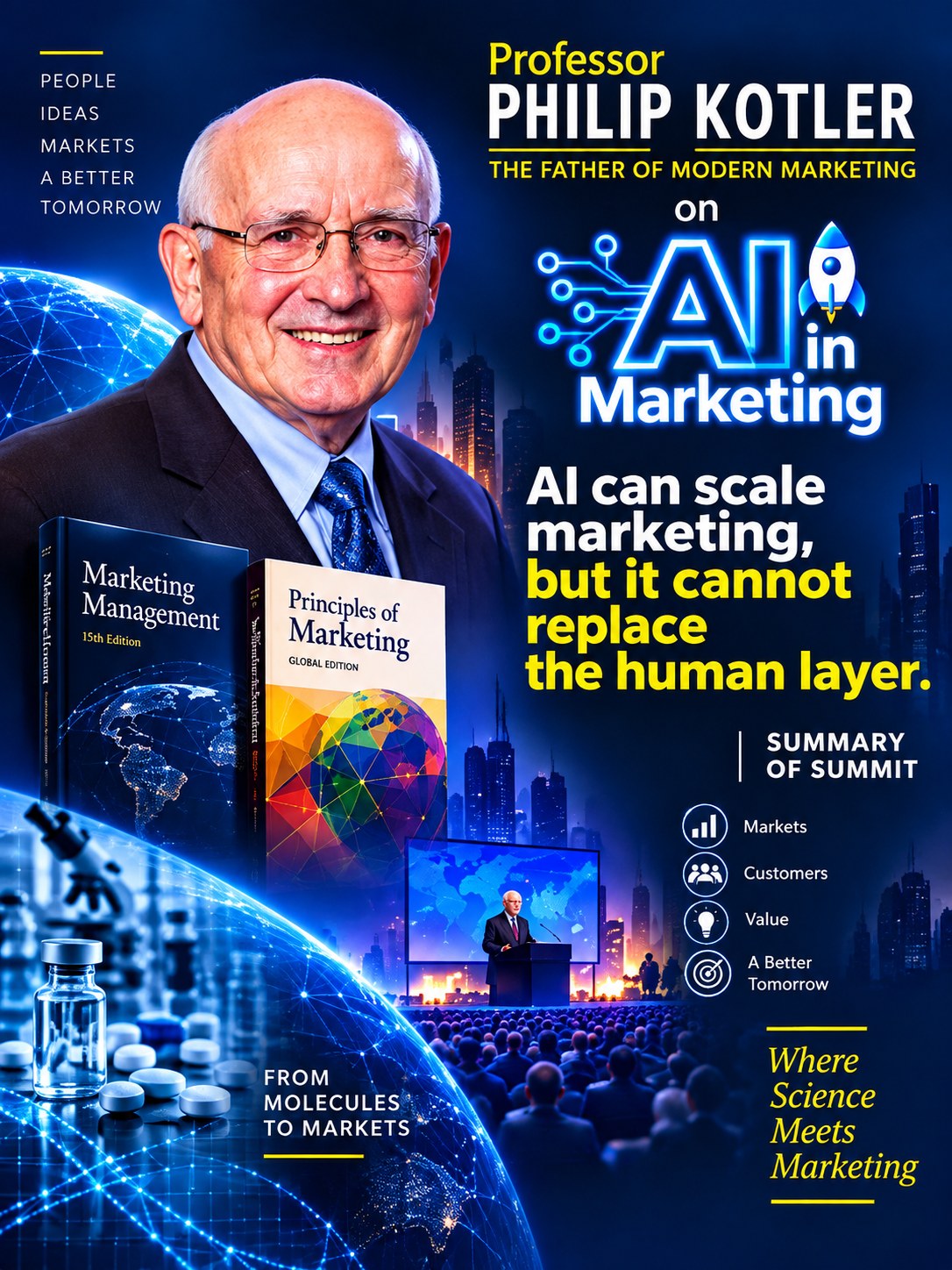
AI in Marketing: Six Key Lessons from Professor Philip Kotler’s Live Session
Six lessons from Professor Philip Kotler's live Marketing Summit session on how AI is transforming marketing—and why customer understanding, trust and human judgment remain essential.
Read more →
FLYER31 October 2026
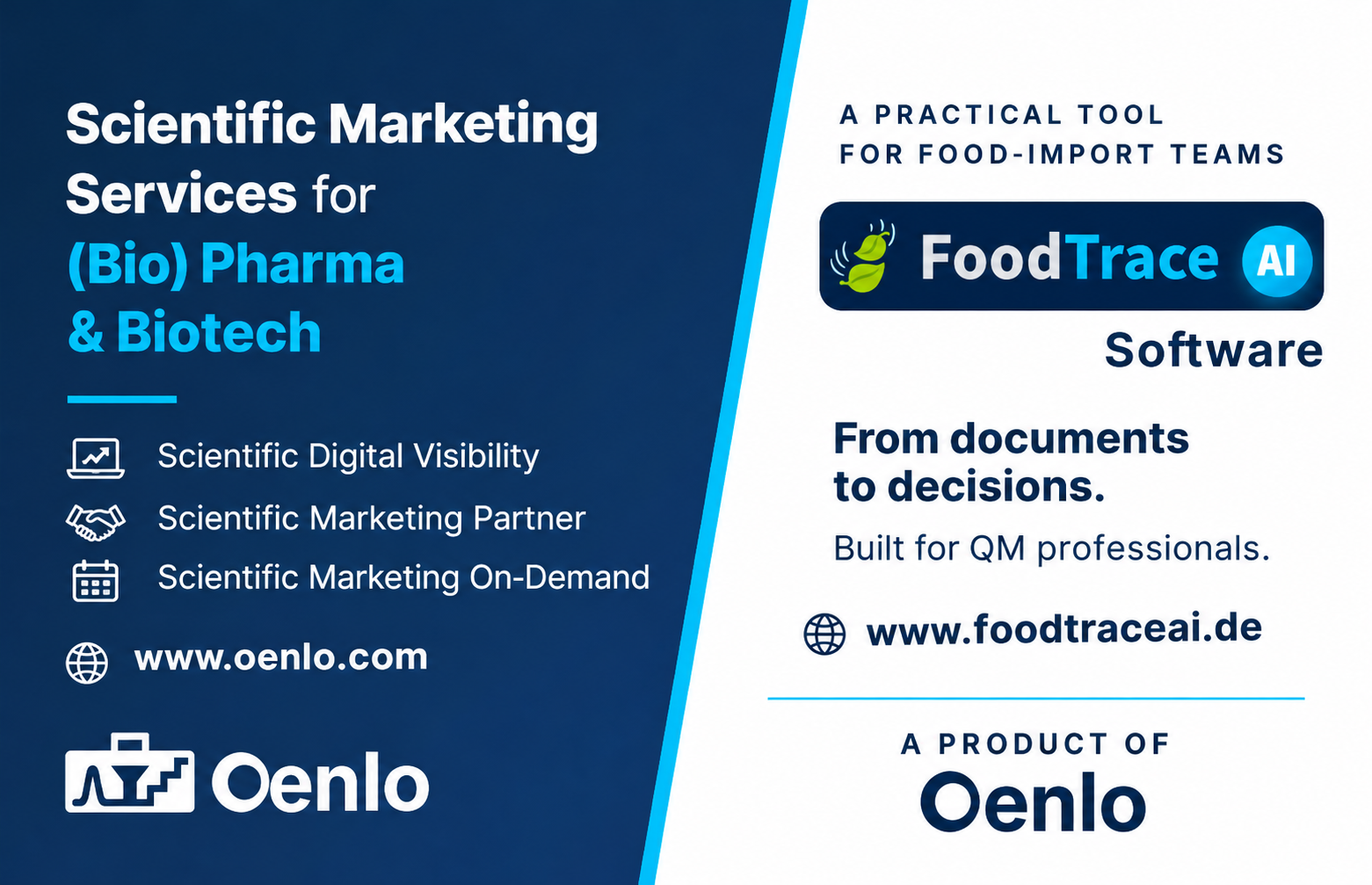
Oenlo — Scientific Marketing Services & FoodTrace AI
An overview of Oenlo's scientific marketing services for (bio)pharma and biotech, alongside FoodTrace AI, a practical software tool for food-import quality management teams.
View flyer →
ARTICLE31 October 2026By Sazzad Karim
Beyond the Lab Bench: Why Digital Marketing is the New Catalyst for Pharma, Biopharma, CDMOs, and CROs
Scientific excellence alone is no longer enough. Explore how digital marketing, thought leadership, and strategic communication are reshaping commercialization across pharma, biopharma, CDMOs, and CROs.
Read more →
ARTICLE12 September 2026
Why strong science stays invisible to AI search
Search is no longer the only route to discovery. When an AI assistant answers a question about a therapeutic area, it draws on sources it can read and attribute — and much scientific content meets neither condition.
Read more →
NEWSLETTEREdition 01 · 5 September 2026
What your CoA says about you
Certificates of analysis are written for regulators and read by procurement. Between those two audiences sits a third that nobody writes for — and increasingly it is a machine.
Read more →
NOTE29 August 2026
Being published is not the same as being found
A short observation on why the two are drifting apart, and what it means for companies whose credibility rests on their science.
Read more →
NOTE1 November 2026
AI in Drug Discovery: Are We Moving Beyond the Hype?
By Sazzad Karim
AI is becoming an increasingly important part of pharmaceutical research. But its real potential goes beyond predicting molecules or accelerating computational workflows.
A recent example is the collaboration between AstraZeneca and insitro, announced on 15 October 2026, to apply AI to identifying disease-driving biological mechanisms and discovering new therapeutic targets.
The collaboration focuses on complex cardiometabolic diseases, including MASH and cardiomyopathies. It combines AI-driven analysis of biological data with pharmaceutical research and development expertise.
The agreement includes $40 million upfront and up to approximately $1.46 billion in potential milestone payments.
My Perspective
The real test of AI in drug discovery is not how many molecules or targets an algorithm can predict.
It is whether those predictions can be translated into experimentally validated discoveries, promising drug candidates and, ultimately, meaningful clinical outcomes.
Scientific validation, differentiated technology and collaboration between AI developers and pharmaceutical researchers will be essential.
AI may accelerate discovery. But biological understanding and experimental evidence remain fundamental.
The key question is not simply what AI can predict, but what science can validate.
A Different Perspective on Wealth and Entrepreneurship
By Sazzad Karim
3F: Family. Fitness. Freedom.
What does real wealth mean to you?
In The Millionaire Fastlane, MJ DeMarco introduces an interesting concept: the three F's of true wealth.
Family: Having meaningful time for the people who matter most.
Fitness: Maintaining the physical and mental well-being to enjoy life.
Freedom: Having greater control over how we spend our time, make decisions, and shape our future.
This perspective becomes particularly interesting when we think about careers, business, and entrepreneurship.
A stable corporate career can provide financial security, professional growth, and valuable experience. Entrepreneurship, on the other hand, offers the possibility of building something independently and creating long-term freedom.
But there is another side to that freedom: Responsibility.
Running a business means accepting uncertainty, making difficult decisions, managing financial risks, and taking responsibility for outcomes. In the early stages, it may actually demand more time and effort than a conventional job.
So perhaps the real objective is not simply to escape employment or become an entrepreneur.
It is to build a sustainable professional and financial foundation that eventually allows us to protect what matters most: our relationships, our health, and our freedom.
Financial success is important. But what that success allows us to do with our lives matters just as much.
Inspired by “The Millionaire Fastlane” by MJ DeMarco.
AI in Marketing: Six Key Lessons from Professor Philip Kotler’s Live Session
Why Human Understanding, Customer Trust, and Marketing Fundamentals Still Matter in the Age of AI
By Sazzad Karim
Session date: 10 September 2026
Some moments have a strange way of taking us back to where we started.
Many years ago, when I was studying B.Pharm in Bangladesh, my main world was science: medicines, formulations, molecules and everything that comes with pharmacy.
But in my very first semester, something else found a place on my study table alongside all those science books.
Marketing.
I had several modules in Marketing and Information Systems, and that was when I first came across a name that almost every marketing student knows:
Professor Philip Kotler.
His books, including Marketing Management and Principles of Marketing, have been important texts for marketing students around the world. His work has had a huge influence on how we understand markets, customers and value, as well as the well-known 4Ps of the Marketing Mix.
But marketing did not remain just a few university modules for me.
After my B.Pharm, I spent almost six years working in pharmaceutical marketing.
Life then took me in another direction. I continued with higher studies in pharmaceutical biotechnology and biotechnology, and the next major chapter of my professional life became biopharmaceutical and analytical science.
And now, the journey is taking another turn as I start building my own venture related to pharmaceutical and life-science marketing.
Then, right at this point in my journey, something quite special happened.
On 10 September 2026, at the age of 95, Professor Philip Kotler joined a Marketing Summit in Bangladesh live, and I had the opportunity to listen to him.
The person whose book was once sitting on my B.Pharm study table was now speaking live, while I was listening from a completely different chapter of my life.
For me, it was more than just another webinar.
It was a small reminder that careers do not always move in a straight line.
Sometimes something you learned many years ago, an earlier chapter of your professional life, or even a book that once sat on your study table can come back years later with a completely new meaning.
Six Key Lessons on AI and the Future of Marketing
Beyond the personal significance of the experience, the session and the panel discussion that followed raised important questions about the future of marketing in an increasingly AI-driven world.
The following six insights reflect my key takeaways from the discussions involving Professor Philip Kotler, Professor Waldemar Pfoertsch and the other speakers.
AI Is Making Marketing Faster and More Scalable, but the Human Side Still Matters
AI can support data analysis, customer segmentation, personalization and content creation.
But a customer is more than a data point. Understanding emotions, psychology, trust and context still requires human judgment.
Reaching Customers More Precisely Is Not the Same as Understanding Them Better
AI enables increasingly personalized communication. But the bigger question is whether we truly understand the customer's needs, context and decision-making process.
Technology should help us understand customers more deeply, not simply reach them more often.
Trust May Become an Even Stronger Competitive Advantage
As AI makes content easier to create, we may face an abundance of content.
The real question then becomes: Which brands will people actually trust?
Credibility, expertise, consistency and authentic human connection may become increasingly important.
AI Is Changing Execution, but Marketing Fundamentals Remain
Tools, channels and automation will change. But the basic questions remain:
Who is the customer?
What problem are we solving?
What value are we creating?
Why should customers choose and trust us?
AI can strengthen a good marketing strategy, but it cannot replace customer value or clear positioning.
Global Technology Still Needs Local Context
Customer behaviour, culture, language, trust and local data differ across markets.
Global AI tools therefore need to be adapted to local realities, particularly in rapidly changing markets such as Bangladesh.
AI Is Not Only an Efficiency Tool
Beyond automation and productivity, AI can help us better understand customer behaviour, patterns, intent and unmet needs.
So perhaps the more important question is not only how much faster AI can make marketing, but how much better it can help us understand the customer.
The Human Side of the Future
Overall, the discussion showed that technology can expand what marketing can do, while human understanding, trust and meaningful customer relationships remain essential.
Looking back, that is also what makes this experience personally meaningful.
My journey has taken me from pharmacy classrooms to pharmaceutical marketing, from biotechnology studies to analytical science, and now towards building something of my own.
The tools and technologies around us are changing. But the connection between science, markets, customers and human understanding remains as important as ever.
AI can scale marketing, but it cannot replace the human layer.
Acknowledgement: Special thanks to "iDEAN Consulting" for organizing the Marketing Summit featuring Professor Philip Kotler.
FLYER31 October 2026
Oenlo — Scientific Marketing Services & FoodTrace AI
An overview of Oenlo's scientific marketing services for (bio)pharma and biotech, alongside FoodTrace AI, a practical software tool for food-import quality management teams.
Beyond the Lab Bench: Why Digital Marketing is the New Catalyst for Pharma, Biopharma, CDMOs, and CROs
By Sazzad Karim
Throughout my journey spanning over a decade in pharmaceutical marketing, product management, and scientific operations—from driving a 300% turnover growth in legacy portfolios to translating complex analytical workflows into published case studies—I’ve witnessed a fundamental paradigm shift.
For the longest time, the healthcare and life sciences sectors operated on a strict demarcation line: the laboratory generated the science, and the sales teams pushed the product.
But today, that line is blurring. In a digital-first global economy, scientific excellence alone is no longer enough to capture market share.
Let's look at how this transformation impacts four critical pillars of our industry:
Pharma & Biopharma
Traditional detailing and physical congresses have evolved. Healthcare Professionals (HCPs) and institutional buyers are researching solutions online long before a sales rep ever calls. Biopharma brands must adopt data-driven storytelling and multi-channel engagement to build trust at scale.
CDMOs (Contract Development and Manufacturing Organizations)
With global supply chains fluctuating, pharmaceutical companies look for outsourcing partners who project absolute reliability and technical mastery. For CDMOs, digital marketing and thought leadership act as the digital storefront—showcasing compliance, agility, and capacity long before the RFP (Request for Proposal) stage.
CROs (Clinical Research Organizations)
Trust is the ultimate currency in clinical trials. CROs are increasingly leveraging content marketing, SEO, and targeted digital strategies to connect with biotech sponsors, streamline patient recruitment insights, and establish scientific credibility globally.
The Takeaway
Whether you are managing complex biosimilar pipelines, scaling a CDMO facility, or coordinating clinical data, the bridge between laboratory innovation and commercial dominance is strategic digital communication.
Search is no longer the only route to discovery. When an AI assistant answers a question about a therapeutic area, it draws on sources it can read and attribute — and much scientific content meets neither condition.
A biotech company spends four years and considerable money generating a body of evidence. It publishes. It presents at conferences. It builds a website that describes its platform in careful, accurate language. Then a prospective partner asks an AI assistant which companies work in that space, and the company is not mentioned.
This is not a ranking problem, and treating it as one leads to the wrong fixes. The question is narrower: can a machine read this content, and can it attribute what it reads?
Readability is not about simplicity
Scientific content frequently fails the first condition for reasons that have nothing to do with the quality of the science. Key claims sit inside PDFs rather than on indexable pages. Platform descriptions are written as capability statements rather than as answers to questions anyone asks. Mechanism, indication and differentiator appear in three separate documents, none of which connects them.
A human reader with domain knowledge reconstructs the connection. A retrieval system does not reconstruct; it retrieves what is already assembled.
Attribution is the harder half
The second condition is stricter. An AI system that summarises a therapeutic area needs to associate a claim with a named organisation, and it needs a source it can point to. Content published only on a third-party platform — a conference site, a partner's page, a social network — may be read, but the attribution often lands elsewhere.
This is why the location of content matters as much as its quality. Substance on someone else's domain builds someone else's authority.
What this means in practice
The remedy is unglamorous. Move substantive claims out of PDFs and onto pages. Write the connections explicitly rather than assuming domain knowledge. Publish first on your own domain and distribute from there. Make sure the organisation is named where the claim is made.
None of this requires changing the science. It requires changing how the science is represented — which is a different discipline, and one most scientific organisations have never had a reason to develop.
NEWSLETTEREdition 01 · 5 September 2026
What your CoA says about you
Certificates of analysis are written for regulators and read by procurement. Between those two audiences sits a third that nobody writes for — and increasingly it is a machine.
I spent years generating the numbers that end up on certificates of analysis. Method development, routine testing, the slow work of establishing that a result means what it appears to mean. What I did not think about then, and think about constantly now, is what happens to that document afterwards.
The document has a second life
A CoA leaves the laboratory as a record of fact. It arrives at a quality manager's desk as a decision input. Somewhere in between it gets forwarded, scanned, redacted, filed, and — increasingly — fed into software that extracts fields from it.
Each of those steps was designed for a different purpose than the one before it. The analyst formats for clarity. The quality manager reads for compliance. The software looks for structure. Most documents serve the first two well and the third badly.
Why this matters more than it used to
For most of the history of quality documentation, the third reader did not exist. A human always sat between the document and the decision, supplying the judgement that filled gaps in the format.
That human is still there, and should be. But the volume has changed. A quality team reviewing fifty supplier documents a week cannot give each the attention a single document once received, and the tooling that closes that gap can only work with what the document actually contains.
A practical consequence
When a document is ambiguous to software, the cost is not a wrong answer — good tooling flags rather than guesses. The cost is that the human has to do the work anyway, and the tooling has added a step rather than removed one.
This is the reason I keep returning to the same design principle: software in a regulated workflow should make the professional's judgement faster to apply, not attempt to replace it. The document was never written for the machine. The machine should accommodate that.
Published as a LinkedIn newsletter. Subscribe to receive future editions.
NOTE29 August 2026
Being published is not the same as being found
A short observation on why the two are drifting apart, and what it means for companies whose credibility rests on their science.
For a long time these were close enough to treat as the same thing. If the work was published in a credible place, the people who needed it would find it. Indexing was the job of librarians and later of search engines, and it worked well enough that nobody had to think about it.
That assumption is quietly breaking. Not because search has become worse, but because an additional layer has appeared between a question and an answer. A growing share of professional enquiry now begins with a system that reads, summarises and decides what to mention — and it makes that decision from whatever it can reach and attribute.
The consequence is uncomfortable for scientific organisations specifically. They tend to have more substance than their visibility suggests, precisely because they invested in the substance and assumed the rest would follow. Organisations with less to say but better digital representation now surface ahead of them.
This is not an argument for marketing louder. It is an argument for noticing that publication and discoverability have become separate problems, and that only one of them is being actively managed.
The newsletter
Published through LinkedIn, with editions archived here. Written for people responsible for how scientific work appears online.
Tell us what you are interested in and we will come back to you. Nothing starts automatically.
Thank you — your enquiry has been received.
We will review the information and respond to discuss fit and next steps.
No work begins until the scope has been agreed with you.
What happens next
You send a short description of what you want to understand.
We review whether an audit is the right fit for it.
A short conversation to confirm scope.
An agreed scope and proposal — before any audit work begins.
Pressing send does not commit you to a project. Where an assessment draws on your own data, we work from authorized access or exports that you provide.